
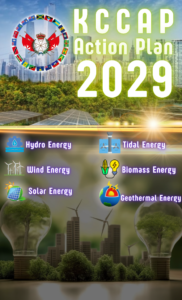
KMFAP CARICOM Climate Action Plan
KMFAP CARICOM
Climate Action PLAN
(KCCAP)-2029
What is renewable energy?
Renewable energy is not just a concept; it’s a reality around us. It’s derived from natural sources that are replenished more than consumed. Sunlight and wind, for example, are such sources that are constantly being replenished. This accessibility not only empowers us but also gives us the ability to make a significant difference in our environment and future.
KCCAP)-Action PLAN-2029
Fossil fuels—coal, oil, and gas—are nonrenewable resources that take hundreds of millions of years to form. When burned to produce energy, they deplete our natural resources and cause significant and harmful greenhouse gas emissions, such as carbon dioxide, contributing to the global climate crisis we face today.
Transitioning from fossil fuels, which currently account for the lion’s share of emissions, to renewable energy is not just a necessity, but a beacon of hope. It’s a promising solution that generates far lower emissions than burning fossil fuels, offering a brighter future and a way out of the climate crisis we face today.
KCCAP)-Action PLAN-2029
The Sustainable Solution
U.S. PATENT PENDING
WHAT ARE WE DOING?
KCCAP) have devised a unique system to address the critical plastic problem that is damaging our oceans and LAND and their delicate ecosystems, with the use of advanced plasma technology our system is a conclusive cure all for mismanaged plastic.
We bring this sustainable solution, onboard our factory ship, directly to the problem, in any of the world’s oceans, river mouths or estuaries to collect and process the plastic waste at the same location.
The benefits of this scheme are multiple, not only will we remove plastics and thus reduce the devasting impact they are having on our oceans and marine life, but the system will power itself and indeed the ship. After initial outlay KCCAP) will also become self funding so that ongoing finance will not be necessary.
As prevention and mitigation of the ocean’s plastic problem go hand in hand, KCCAP)-Action PLAN-2029 will also install land based plants on Any landfill dump sites throughout any CARICOM Caribbean country once operational. At absolutely no cost to the government 100% financing by NGOs, Associated to KCCAP) KMFAP CARICOM This will afford visionary organisationsand governments a sustainable, environmentally friendly technology to recycle their by-products and waste into valuable energy and resources.
THIS IS KMFAP CARICOM KNIGHT COMMANDER GIF TO CARICOM KCCAP)-Action we cannot move forward as a society when good men do nothing,
Taking a holistic approach, the KCCAP)-Action PLAN-2029 model is the only sustainable solution that addresses the 3 pillars of plastic and waste mismanagement and its subsequent pollution and damage in our oceans, & LAND
Our three-pronged approach encompasses the ocean, rivers and land, remedying both the symptoms and cause.
OCEAN, RIVER, LAND,
We would not allow the uncontrolled fly-tipping or dumping of waste on land yet it occurs in our oceans and rivers daily. The problem which was once out of sight and in turn mind, is now suffocating our planet, destroying ocean wildlife and their habitats.
The KCCAP) vessel has the capacity to remove and revalue the existing plastic and waste at sea on site at the chronic locations such as the Gyres that have created the Great Pacific Garbage Patch..
Renewable energy sources are not only environmentally friendly but also economically advantageous. They are not just cheaper in most countries, but also generate three times more jobs than fossil fuels, making them a smart and sustainable choice for our future.
Here are a few familiar sources of renewable energy:
SOLAR ENERGY
Solar energy is the most abundant energy resource and can even be harnessed in cloudy weather. The rate at which the Earth intercepts solar energy is about 10,000 times greater than the rate at which humankind consumes energy.
Solar technologies can deliver heat, cooling, natural lighting, electricity, and fuels for various applications. They convert sunlight into electrical energy through photovoltaic panels or mirrors concentrating solar radiation.
Although not all countries are equally endowed with solar energy, every country in CARICOM can significantly contribute to the energy mix through direct solar power.
KMFAP CARICOM’s KCCAP)-Action PLAN-2029 goal and Mission by 2036 is to have a research facility in every country in the CARICOM, Training young men and women about renewable energy and how to invest their time and energy into bringing Down emissions with research and development in pioneering new technology by using NGO & nonprofit organization’s to sponsor grants and scholarship for these young men and women
The cost of manufacturing solar panels has plummeted dramatically in the last decade, making them affordable and often the cheapest form of electricity. Solar panels have a lifespan of roughly 30 years and come in a variety of shades depending on the type of material used in manufacturing.
WIND ENERGY
Wind energy harnesses the kinetic energy of moving air by using large wind turbines located on land (onshore), sea, or freshwater (offshore). Although wind energy has been used for millennia, onshore and offshore wind energy technologies have evolved over the last few years to maximize the electricity produced, with taller turbines and larger rotor diameters.
Though average wind speeds vary considerably by location, the world’s technical potential for wind energy exceeds global electricity production, and ample potential exists in most regions of the world to enable significant wind energy deployment.
Many parts of the world have substantial wind speeds, but the best locations for generating wind power are sometimes remote. Offshore wind power offers tremendous potential.
GEOTHERMAL ENERGY
Geothermal energy utilizes thermal energy that is accessible from the Earth’s interior. Heat is extracted from geothermal reservoirs using wells or other means.
Reservoirs that are naturally sufficiently hot and permeable are called hydrothermal reservoirs, whereas reservoirs that are adequately hot but improved with hydraulic stimulation are called enhanced geothermal systems. Right here in the Caribbean, we have one of the largest Geothermal energy sources in the world.
Once at the surface, fluids of various temperatures can be used to generate electricity. The technology for electricity generation from hydrothermal reservoirs is mature and reliable and has been operating for over 100 years.
HYDROPOWER
Hydropower harnesses the energy of water moving from higher to lower elevations. It can be generated from reservoirs or rivers. Reservoir hydropower plants rely on stored water in a reservoir, while run-of-river hydropower plants harness energy from the river’s available flow.
Hydropower reservoirs often have multiple uses: providing drinking water, irrigation water, flood and drought control, navigation services, and energy supply.
Hydropower is currently the largest source of renewable energy in the electricity sector. It relies on generally stable rainfall patterns and can be negatively impacted by climate-induced droughts or ecosystem changes that impact rainfall patterns.
The infrastructure needed to create hydropower can also adversely impact ecosystems. For this reason, many consider small-scale hydro a more environmentally friendly option and especially suitable for communities in remote locations.
OCEAN ENERGY
Ocean energy is derived from technologies that use seawater’s kinetic and thermal energy – waves or currents, for instance – to produce electricity or heat.
Ocean energy systems are still in the early stages of development, with several prototype wave and tidal current devices being explored. The theoretical potential for ocean energy easily exceeds present human energy requirements.
BIOENERGY
Bioenergy is produced from various organic materials called biomass, such as wood, charcoal, dung, and other manures for heat and power production and crops for liquid biofuels. Poorer populations in developing countries use most biomass in rural areas for cooking, lighting, and space heating.
modern biomass systems include dedicated crops or trees, residues from agriculture and forestry, and various organic waste streams.
The energy created by burning biomass creates greenhouse gas emissions but at lower levels than burning fossil fuels like coal, oil, or gas. However, bioenergy should only be used in limited applications, given the potential adverse environmental impacts of large-scale increases in forest and bioenergy plantations, resulting in deforestation and land-use change.
KMFAP CARICOM &
KCCAP)-Action PLAN-2029
is more than eager to whole talks with government heads, & ministers of energy to implement several various Affordable energy Solutions Some witch is 100% finance by NGOs, Associated With KMFAP CARICOM
Sir Samuel J Stafford
Knight of Malta, &
Knight Commander of Cyprus